
Live Updates: 6 People Are Missing After Baltimore Bridge Collapse
The crew of a cargo ship issued a “mayday” saying that it had lost power and propulsion before hitting the bridge, the authorities said, calling it an accident.
Here’s what we know about the collapse.
A massive cargo ship leaving the Port of Baltimore lost power and issued a mayday call shortly before striking a major bridge early Tuesday, giving officials a brief chance to stop cars and try to evacuate the span before it fell into the river.
By Tuesday morning, six construction workers who had been fixing potholes on the Francis Scott Key Bridge remained missing as divers and other emergency workers on boats and helicopters continued to search for them. Two others had been rescued.
Gov. Wes Moore of Maryland called it a terrible accident. “We haven’t seen any credible evidence of a terrorist attack,” he said. The bridge is part of Interstate 695.
Initially, officials feared that drivers were submerged in their cars in the Patapsco River. But the warning from the Dali, a Singapore-flagged vessel, gave officials enough time to stop traffic at both ends of the bridge, according to several federal and Maryland officials.
The people who blocked traffic saved lives, Mr. Moore said. “These people are heroes.”
Here are more details:
• Governor Moore declared a state of emergency and said that his office was in close communication with Pete Buttigieg, the U.S. transportation secretary. The White House issued a statement saying that President Biden had been briefed on the collapse.
• Despite the ship’s mayday, the road repair crew remained on the bridge, with their vehicles parked on the span, the authorities said. One of the two rescued construction workers was in the hospital on Tuesday morning.
• The Dali, a 948-foot-long cargo vessel, hit a pillar of the bridge around 1:30 a.m., the ship’s owners said. All crew members, including two pilots onboard, were accounted for, and there were no injuries on the ship, the owners said.
• The Dali had left Baltimore at 1 a.m. and was bound for Colombo, Sri Lanka, according to MarineTraffic, a maritime data platform.
• The bridge was named after Francis Scott Key, the Maryland-born author of the American national anthem, “The Star-Spangled Banner.” The structure opened in 1977. Some 30,000 commuters drive on it each day, Maryland officials said.
The ship’s mayday call prompted officials to stop traffic to the bridge.
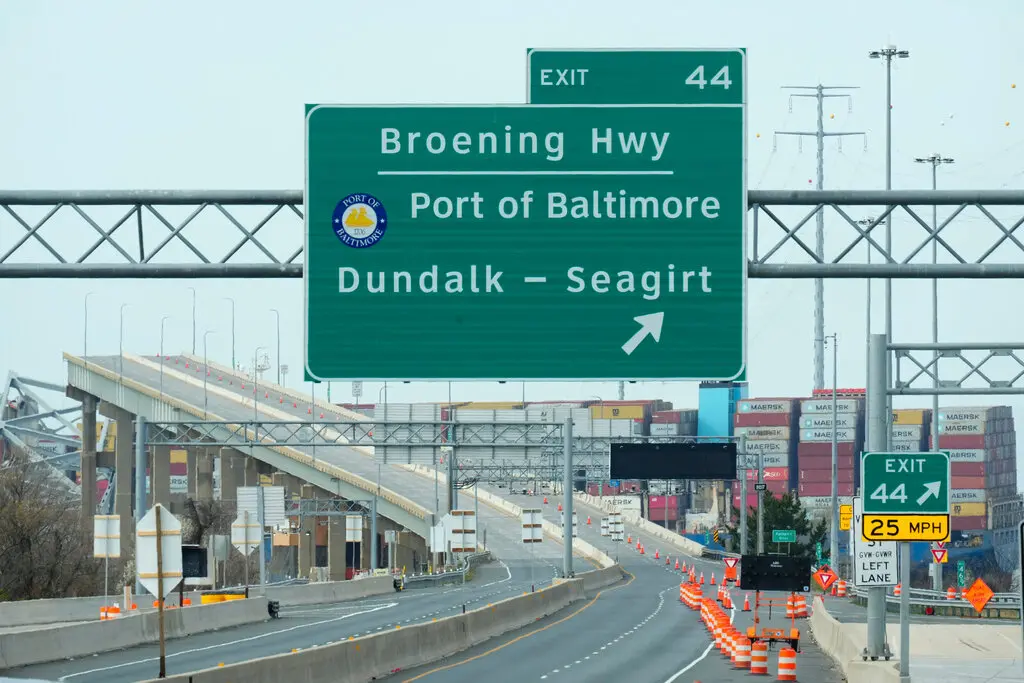
A mayday call enabled officials to stop traffic at both ends of Baltimore’s Francis Scott Key Bridge and try to evacuate people from the span before it collapsed on Tuesday, according to several federal and Maryland officials.
The crew of the large container ship leaving the Port of Baltimore told Harbor Control that they had lost power and propulsion, the officials said.
The ship “drifted into the bridge,” said Chris Van Hollen, a Democrat and Maryland’s junior senator. “Before it hit the bridge, it issued a mayday warning, which did give folks enough time to stop some of the traffic crossing the bridge.”
Mr. Van Hollen said that the investigation was still in its early stages but added that early indications suggested that because of the closure, no traffic was crossing the bridge during the collapse. He said vehicles used by a road crew fixing potholes had been parked on the bridge and appear to have been plunged into the water.
Mr. Van Hollen and a U.S. official briefed on the incident said it was not clear how much time had elapsed between the mayday call and the ship’s crash into the bridge.
Shortly after the crash, radio traffic from emergency workers suggested that the crew was also struggling to steer the ship, according to audio published by Broadcastify.
Recent collapses raise questions on bridges and modern shipping.
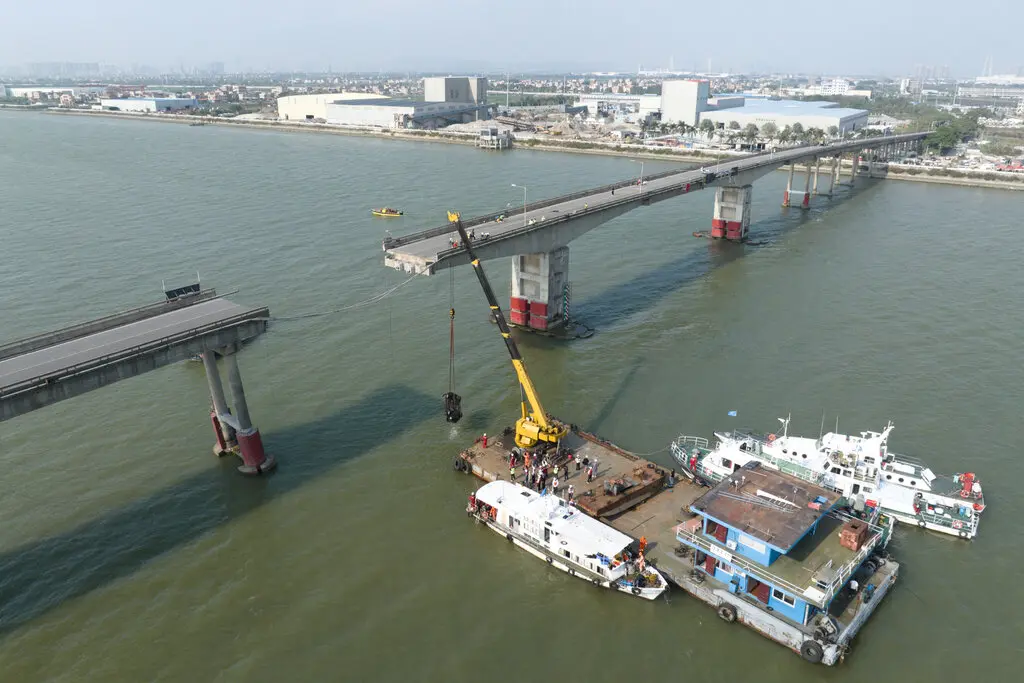
The site where a container ship hit a bridge in Guangzhou, China, in February.Credit…China Daily/Via Reuters
Tuesday’s crash was at least the second in just over a month in which a container ship hit a major road bridge, raising questions about the safety standards of increasingly large ships and the ability of bridges around the world to withstand crashes.
On Feb. 22 in Guangzhou, a port in southern China, a much smaller vessel carrying stacks of containers hit the base of a two-lane bridge, causing vehicles to fall. Officials said that five people were killed.
The crashes have also raised questions about whether more ships should be required to be ready to drop anchors quickly during port emergencies, and whether tugboats should accompany more vessels as they enter and leave harbors.
There has not been a final report on the Guangzhou incident, and investigators have barely begun to look at what happened in Baltimore. But ship collision barriers are standard around the support piers of bridges over major waterways like the entrance to Baltimore’s harbor. The Verrazzano-Narrows Bridge in New York City, for example, has massive barriers of concrete and rocks around the bases of the piers that support it.
It was not immediately clear how old the barriers are around the piers that supported the bridge in Baltimore. The bridge was built almost half a century ago and designed before then. Vessels have become considerably larger in that time.
The crash in Guangzhou occurred on a less important waterway, a minor channel of the Pearl River. The bridge there was being fitted with devices designed to protect the piers in case of any ship crash. The work was supposed to have been completed by 2022 but had been delayed, and the latest target for completion was August of this year, according to China Central Television, the state broadcaster.
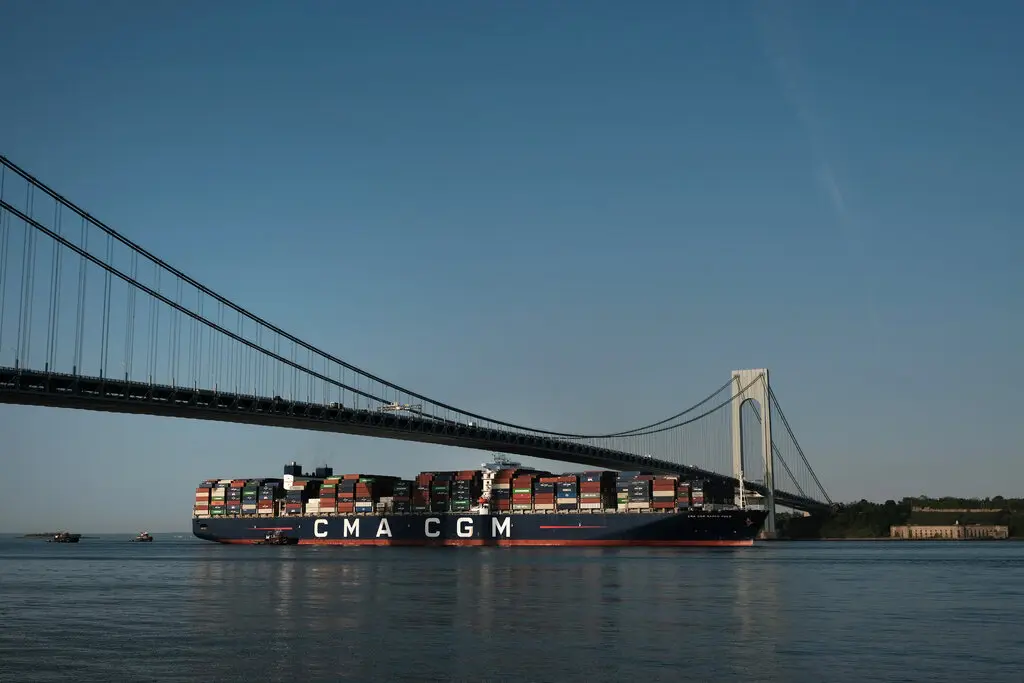
The Verrazzano-Narrows Bridge in New York in 2021. The bridge has massive barriers of concrete and rocks around the bases of the piers that support it and protect it from ship crashes.Credit…Spencer Platt/Getty Images
Harbor pilots and crews of many large ships have two anchors ready to drop as they enter or leave a harbor, in case an emergency such as a loss of power means that they need to try to stop quickly. Basil M. Karatzas, the chief executive of Karatzas Marine Advisors, a ship inspection company in New York, said that while he had seen tanker crews commonly take this precaution, it was less common for container ships.
“The anchors have to be unlocked and ready to be dropped, and this takes some time to prepare, as generally crew members physically at the bow have to unlock them and release them,” he said. “That’s not something you can do in an emergency.”
Large ships are often accompanied by tugboats as they leave or enter harbors so that the tugboats can push them away from harm if the ship has difficulties. It was not immediately clear whether tugboats had accompanied the ship that struck the bridge on Tuesday.
The ship in Baltimore was exiting the harbor as a spring tide was rushing out of the harbor. The moon was still almost completely full, having reached its fullest less than 24 hours earlier.
Full moons in springtime are associated with some of the largest tidal changes in local sea level. And while Baltimore’s harbor experiences fairly small changes even during springtime full moon tides, tidal movements of water could have been a factor in the bridge impact.
“The ebbing tide increases the speed of the water seaward, which effectively has a cumulative effect on the speed of an outbound vessel, and any currents in the water could also have complicated navigation,” Mr. Karatzas said.
Amy Chang Chien contributed research.
After the ship hit the bridge, a collapse seemed inevitable, engineers say.
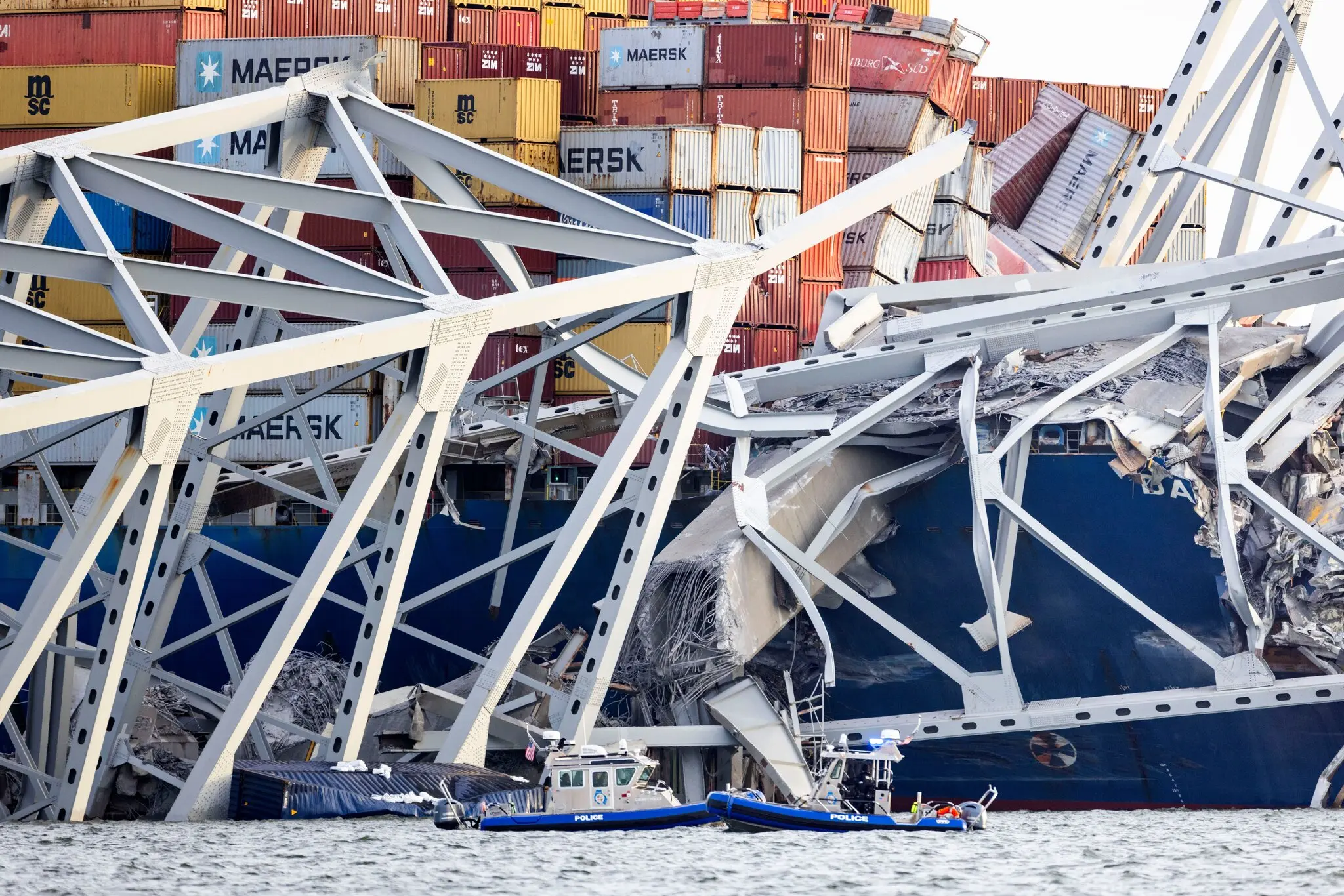
A portion of the Francis Scott Key Bridge resting on top of the Dali container ship in Port of Baltimore on Tuesday.Credit…Jim Lo Scalzo/EPA, via Shutterstock
The dramatic video of the collapse of the Francis Scott Key Bridge in Baltimore will probably lodge itself in many people’s minds for a long time. But for engineers, seeing the footage might offer insight into why the span fell so quickly.
While it’s hard to know exactly what happened just from watching video, the impact of the major container ship on a key part of the bridge made the collapse of the bridge “pretty evident,” said Mark Richards, a structural engineer based in Britain who has worked in the field for 35 years. He was not involved in the construction of the Key Bridge.
When bridges are designed, Dr. Richards said, many scenarios — including risks and worst-case possibilities — are taken into account before the structures are built. Legislation also often requires that such possibilities are taken into account, he said.
Yet planning for any possible outcome is tough, he said.
“We can’t design every structure to accommodate every single possible event,” he said. But, he added, “these sorts of incidents are very, very, very rare.”
An investigation will have to show what went wrong, and which safeguards were in place to prevent such incidents. Other factors also have to be considered, he said, including the size and weight of the ship.
Sanjay R. Arwade, a professor of civil engineering at the University of Massachusetts Amherst, said that if the vessel had taken out one of the bridge’s two support piers, as it appeared to have done, a collapse would be almost inevitable.
“For any long-span bridge,” he said, “the complete loss of one of the piers is going to be catastrophic.”
Baltimore’s port handled a record amount of cargo last year.
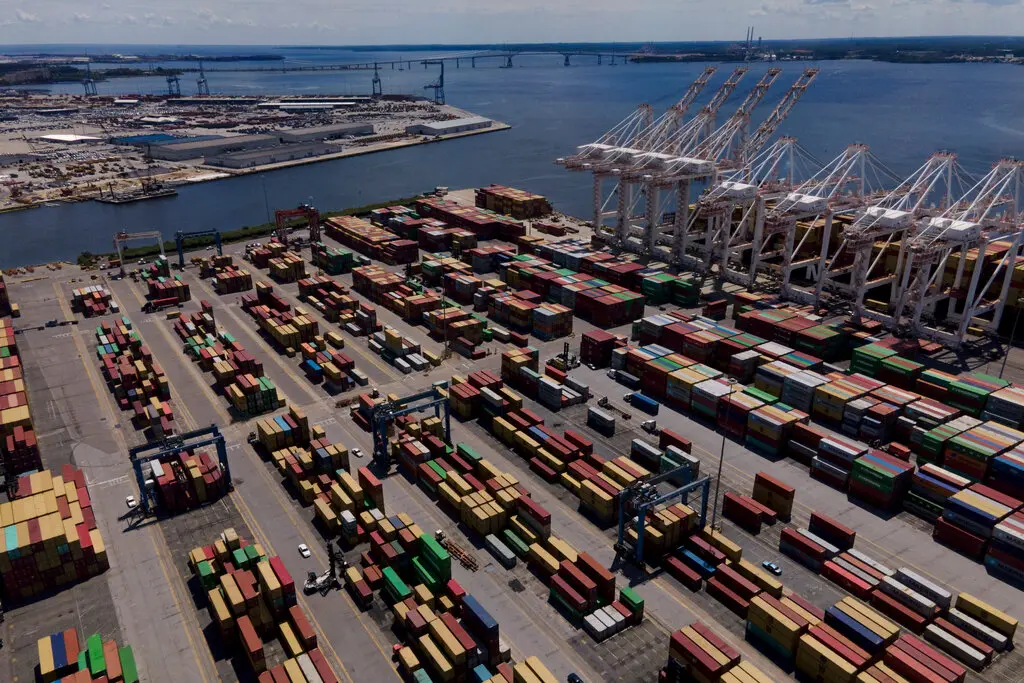
Shipping containers stacked at the Port of Baltimore in 2022.Credit…Julio Cortez/Associated Press
The collapse of the Francis Scott Key Bridge has brought the Port of Baltimore, an important trade hub, to a halt.
The port handled a record amount of foreign cargo last year, and it was the 17th biggest port in the nation overall in 2021, ranked by total tons, according to the Bureau of Transportation Statistics. It ranks first in the United States for the volume of automobiles and light trucks it handles and for vessels that carry wheeled cargo, including farm and construction machinery, according to a statement by Gov. Wes Moore of Maryland last month.
Around the world, about 40 ships, including 34 cargo vessels, have Baltimore listed as a destination, including 10 commercial ships with anchors dropped in nearby waters, according to MarineTraffic, which tracks ships.
Georgios Hatzimanolis, who analyzes global shipping for MarineTraffic, said he expects the bridge collapse to cause shipping delays. “We do expect there to be a ripple effect, but it’s a bit too early to say what the impact will be,” he said. Ships heading to Baltimore with cargo to unload may instead go to ports in New Jersey or North Carolina, he said.
The port, which supports more than 15,000 jobs, has also increasingly catered to large container ships like the Dali, the 948-foot-long cargo vessel carrying goods for the shipping giant Maersk that hit a pillar of the bridge around 1:30 a.m. on Tuesday. The Dali had spent two days in Baltimore’s port before setting off toward the 1.6-mile Francis Scott Key Bridge.
The arrival of large container ships to the port “continues to demonstrate Baltimore’s capabilities of handling supersized vessels,” Governor Moore said in the statement. The largest container ship ever to enter the port, as of February, arrived last year with the capacity to carry more than 15,000 20-foot containers.
State-owned terminals, managed by the Maryland Port Administration, and privately owned terminals in Baltimore transported a record 52.3 million tons of foreign cargo in 2023, worth $80 billion. The port handled nearly 850,000 cars and light trucks last year, more than in any other U.S. port for the past 13 years.
Other materials transported in large volumes through the city’s port include coal, coffee and sugar. It was the ninth-busiest port in the nation last year for receiving foreign cargo, in terms of volume and value.
The bridge’s collapse will also disrupt cruises traveling in and out of Baltimore. Norwegian Cruise Line last year began a new fall and winter schedule calling at the Port of Baltimore.
A correction was made on March 26, 2024:
An earlier version of this article misstated the Port of Baltimore’s rank among U.S. ports. It was the nation’s 17th biggest port by total tons in 2021, not the 20th largest.

